Finding the Story (Part 2)
The Apprehension of Shame and the 1874 Breakthrough
For over a decade, my startup had been a thief of time, burying the "Saturnino Ximénez" folder under the hollow, relentless noise of existential startup dread. But, as the city stilled for the holidays, in the sudden, heavy silence of Saigon during Tet 2025, the ghosts of years of fragmented obsession returned: the six-year-old girl who made her classmates kiss her ring in hopes of a Russian title, the teenager who failed Russian 101, and the IT professional who had spent decades using her ancestor as a search-engine test case. When I finally sat down to open the Saturnino Ximénez folder on my laptop, it felt like meeting an old friend—but it was a friend who had previously caused me a great deal of anxiety.
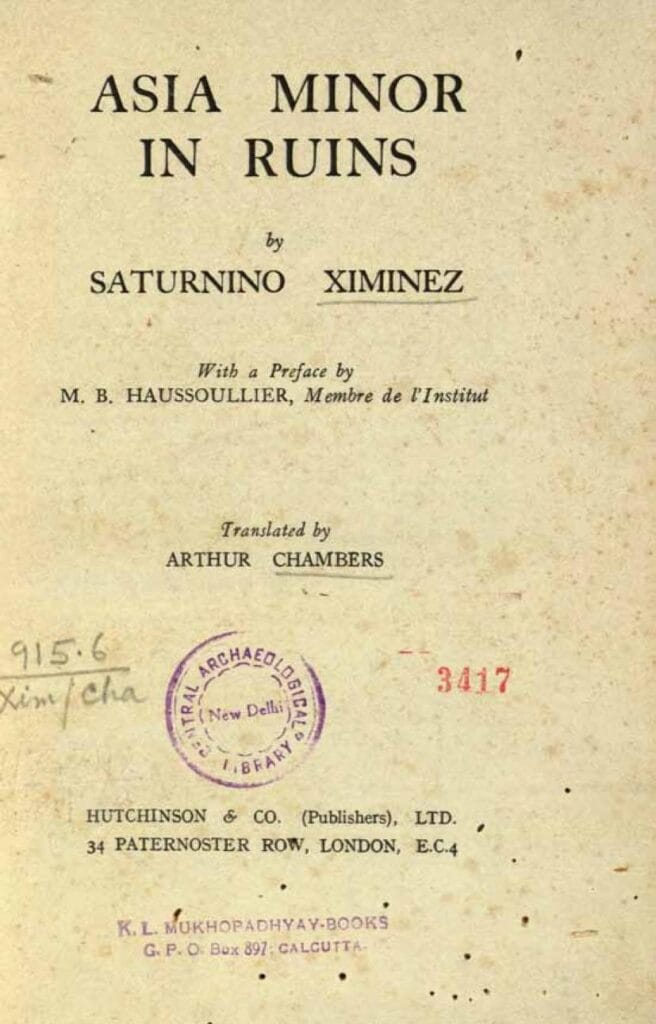
As a woman born in 1973, my first serious encounter with Saturnino’s actual writing was jarring. I picked up his magnum opus, Asia Minor in Ruins, and by Chapter II, "Mount Olympus," I hit a wall of language that, in my lifetime, had become exclusively associated with the Third Reich and the Holocaust.
"The Aryan thrust westward from the high plateau of Phrygia rapidly descended to the shores of the Aegean Sea..."
Seeing my great-grandfather use terms like "Aryan peoples," "Aryan thrust," and discussing the purity of races triggered a visceral fear.
I worried that the "man of 25,000 books" was an ideological precursor to National Socialism—that his obsession with the struggle of Asia against Europe was a manifesto of racial supremacy.
I feared I was uncovering a legacy of intellectual shame.
The Wall of Context
This apprehension wasn't limited to his magnum opus. His pamphlet Kurds & Armenians was equally opaque to me; I simply didn't understand enough of the context to tell if his observations were offensive or the opposite. His other works—Anales de la Cruz Roja, Memorias de la Pacificación, and España en el África Septentrional—were dense, academic, and seemingly inaccessible.
I realised that if I were ever going to understand the man, I would first need to educate myself on the entire 19th-century geopolitical stage. It felt like a Herculean task, one that justified cooling off on the idea of a novel altogether. Still, for the next ten years, while I was building a startup in Vietnam and keeping my head above water, I subconsciously collected bits of context. I gathered snippets of history as I had gathered archive files, waiting for the moment I had the mental bandwidth to synthesise them.
The Puzzle vs. The Manifesto
By the time the quiet of the 2025 Lunar New Year arrived, my perspective had evolved. Through those years of incremental learning, I realised that Saturnino was using "Aryan" in the standard 19th-century academic sense—as a synonym for what we now call "Indo-European."
He wasn't trying to prove the superiority of a master race; he was trying to solve a historical puzzle. He wanted to know how the "Hellenic genius" arrived in the Mediterranean. He was tracing the migration of ideas, languages, and cultures across the high plateaus of history. Suddenly, it didn't sound like a manifesto; it sounded like the kind of story I wanted to tell—a mystery of origins that any historical fiction writer would envy.
The Fiction Dilemma: Europe, Future, or Ghost?
But knowing the story wasn't enough; I was paralysed by the ethics of fictionalisation. I found myself caught in an intellectual vertigo: how could I separate the factual man from the narrative creature for my readers? More importantly, how could I protect the legacy for my nieces? I wanted them to know their great-great-grandfather in all his brilliance, but I feared that by weaving him into a thriller, I might accidentally overwrite the real man with a fictional ghost.
The setting presented its own hurdle. I had spent years absorbing the details of 19th-century Europe, yet I felt a profound lack of desire to write about it. It felt too settled, too dry, too much like a museum I was forbidden to touch. Nor was I interested in projecting Saturnino into a contemporary, future setting. Contemporary fiction simply isn't my genre; I needed the weight of the past, but I needed it to feel alive, dangerous, and undiscovered.
As the ten-day holiday drew to a close, I was ready to admit defeat. The grindstone of the startup was waiting, and I still lacked a setting, a strategy, or a voice. I felt like a tired detective at the end of a cold case—someone who had spent a decade chasing a ghost only to find that the spirit was unwilling to speak.
The Last Look: The 1874 Breakthrough
Like that disappointed detective who has been ordered to box up the evidence and close the file, I decided to open the folder one last time. It was a purely sentimental gesture—one last look before I put this flight of fancy to bed for good.
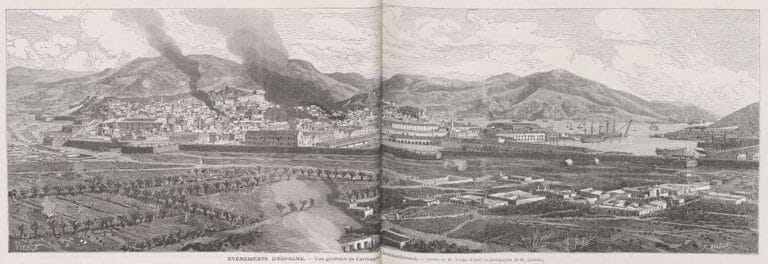
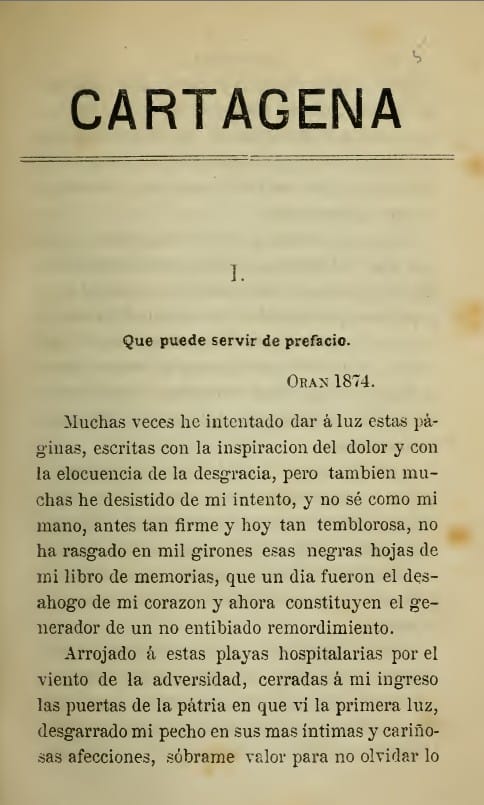
I began clicking through the 1874 digital artifacts. I looked at the scanned preface of his memoir, Cartagena, explicitly signed and datelined "Oran, 1874." It was his own writing, his own claim to a romantic, tragic exile in North Africa. I turned back to María José Vilar’s meticulous research. Her article laid out the scholarly case for his time in Algeria.
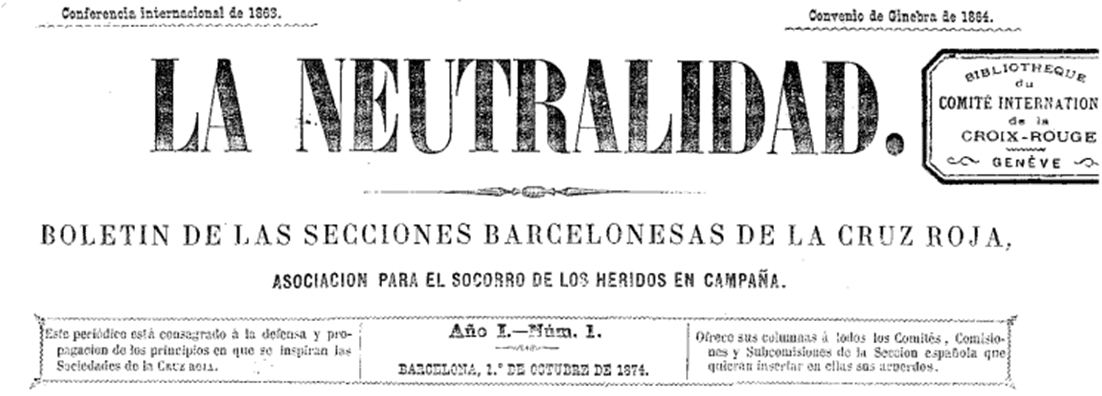
Then, I toggled to the masthead of the Barcelona journal, La Neutralidad, dated just a few months after the end of the Rebellion, listing him as the Director at Calle del Hospital, 36, Barcelona.
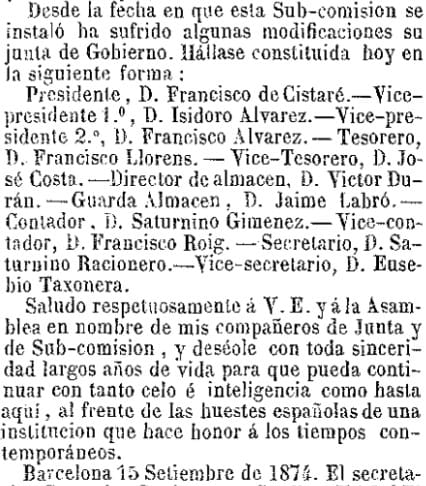
In that moment, Saturnino’s talent for creating a Great Blur became my salvation. I saw the contradiction—the beautiful, documented impossibility of him being in two places at once. That was the leverage I needed.
If the historical record was already fractured, then the Firewall was not a betrayal; it was an extension of Saturnino’s own talent for ambiguity.
If he could be a refugee in Africa and a director in Catalonia simultaneously, he could be anywhere.
He could be in Manila. He could be a journalist seeking redemption. He could be a man of 25,000 books lost in a colony of censors and revolutionaries. A path, forged in the fires of the Cartagena uprising and winding through the shifting, uncertain sands of the Oran refugee camps, began to emerge. The road to Manila—and The Mariquina Manuscript—finally opened up.