The Great Divergence
The Mystery of 1874 and Why it Changed Everything.
Every historical novelist has a What If moment—a single point in time where the archival record turns left, but the imagination insists on turning right. For The Saturnino Ximénez Files, that moment is 1874. We call it The Great Divergence.
In the real world, 1874 was the year my great-grandfather, Saturnino Ximénez Enrich, transitioned from a twenty-year-old revolutionary to a twenty-one-year-old technocrat of mercy in Barcelona. But in the world of the novels, 1874 is the year he vanishes into the humid, shadow-drenched corridors of the colonial Philippines.
Why 1874? The more I dug into the archives, the more I realized that 1874 wasn't just a convenient place to start a story—it was a year already fractured by two competing historical narratives.
The 1874 Discrepancy: Oran vs. Barcelona
Before we even get to the fiction, the "Fact" of 1874 is already a mystery. Two distinct versions of Saturnino's life emerge from this single year.
1. The Narrative of Exile (Oran)
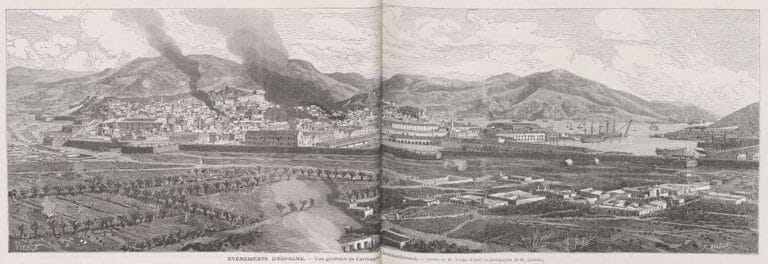
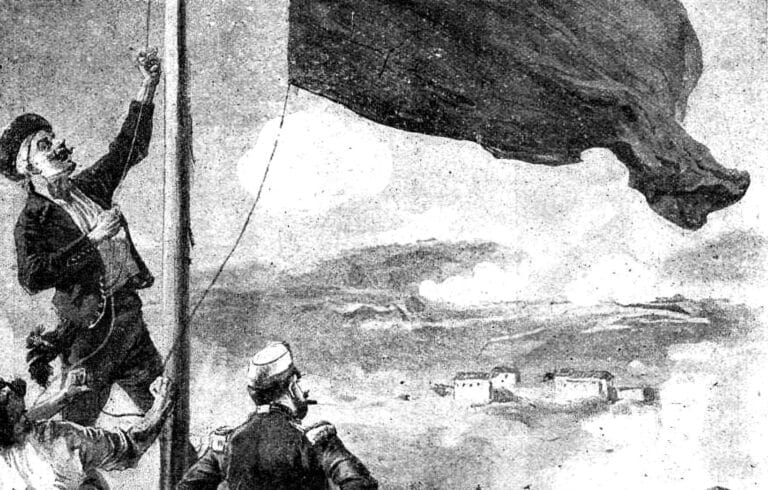
The traditional account, supported by historians and Saturnino’s own early literary works, holds that he fled Cartagena following the collapse of the Cantonalist rebellion.
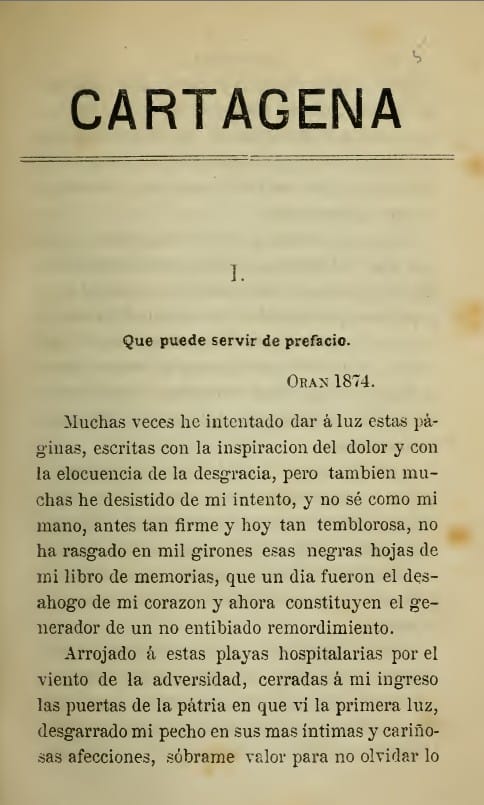
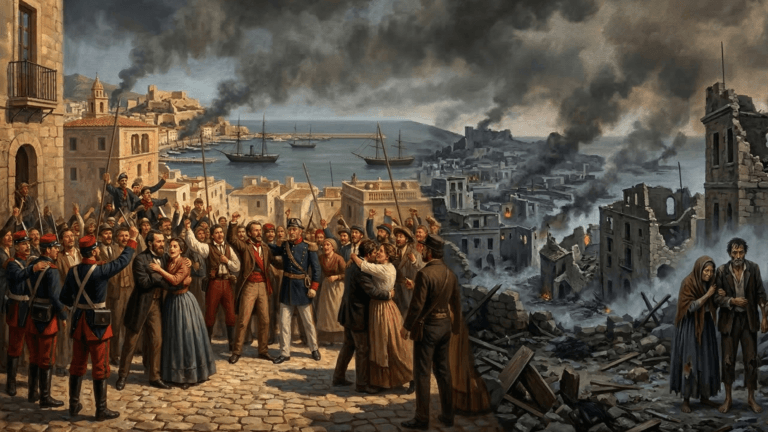
- The Flight: On January 12, 1874, as the Canton fell, the ironclad frigate Numancia broke the blockade and sailed for Oran, Algeria, with a thousand refugees. Saturnino describes this cinematic escape in his first book, Cartagena (Recuerdos Cantonales).
- The Refugee: Historians such as María José Vilar state that Saturnino lived in Algeria as an exile, working in journalism until an amnesty allowed his return.
- The Literary Proof: The most direct claim comes from Saturnino himself; the preface to his memoir Cartagena is explicitly signed and datelined "Oran, 1874."
2. The Narrative of Residence (Barcelona)
Documentary evidence regarding his professional activities contradicts the idea of a prolonged African exile, placing him firmly in Barcelona during the exact months he was supposedly in a refugee camp.
- Red Cross Official: In August 1874, Saturnino published the Anales de la Cruz Roja in Barcelona—a massive work commissioned by the Spanish Assembly of the Red Cross.
- Contador of La Neutralidad: Most damning to the exile narrative is the bulletin of the Red Cross in Barcelona. The masthead provides the specific address in Barcelona: Calle del Hospital, 36. He is listed as the "Contador" (Accountant) for the organization as early as September 1874.
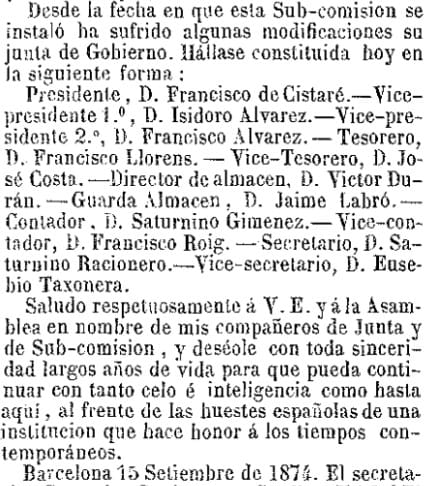
Sources indicate he was a "distinguished member" of the new Barcelona Red Cross, participating in high-society benefit concerts while his fellow insurgents were still in prison.
A Romantic Misinterpretation?
The discrepancy suggests that Saturnino's exile was either extremely short-lived or largely a fabrication. Modern analysis suggests his prolonged exile may be a romantic misinterpretation of his own first-person novel. It appears Saturnino used the confusion and myth of the Oran refugee camps to curate his own biography, allowing him to hide his radical past while reintegrating into the Barcelona bourgeoisie.
The Fiction: The Shadow Operative
In the fictional timeline of The Mariquina Manuscript, we take this "Great Blur" and push it even further. We ask: What if the "air of a spy" that the writer Josep Pla later detected in Saturnino was not a metaphor, but an inevitable vocation?
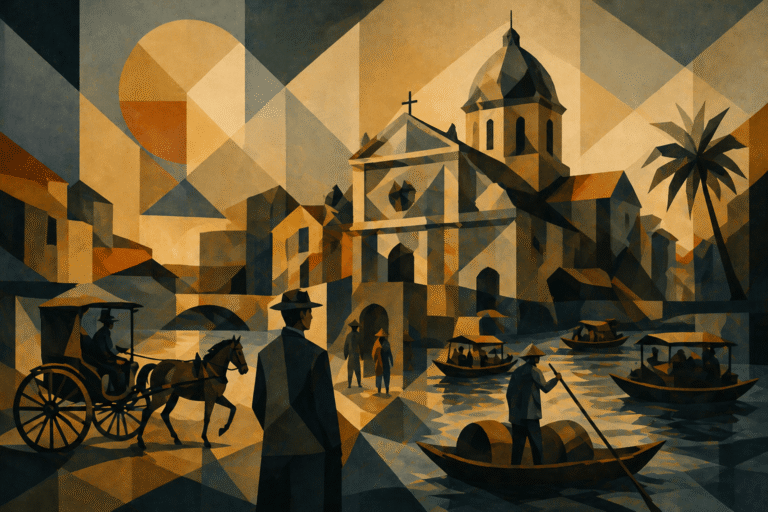
In the novels, 1874 is the year Saturnino gets on a steamship heading East. Carrying the trauma of the Cartagena bombardment, he arrives in Manila seeking redemption through a new vocation: honest journalism. He intends to be a chronicler of truth, far from the reach of the Madrid censores.
However, his insatiable thirst to understand the hidden gears of colonial society inevitably pulls him down a spy-like path, drawing him into a Philippines that is itself a powder keg, caught between the archaic "Red Pencil" of the Spanish authorities and the rising tide of Enlightenment thinking.
The "Firewall" Strategy
As an author, I maintain a strict "Firewall" between these two Saturninos. I use the Archive Files on this site to honor the historical man—the polyglot who translated Chekhov and survived the siege of Minsk.
However, because the official records are riddled with significant lacunae, I use the novels to illuminate the blindspots of his history, projecting the man he might have been into the silences we cannot otherwise reach. By establishing a distinct point of origin for this fictional version of him, I can better navigate the boundary between the documented and the imagined—clarifying exactly where the archival ink fades and the narrative begins.
One Saturnino lived the history. The other is helping me uncover the truth of the man himself.